

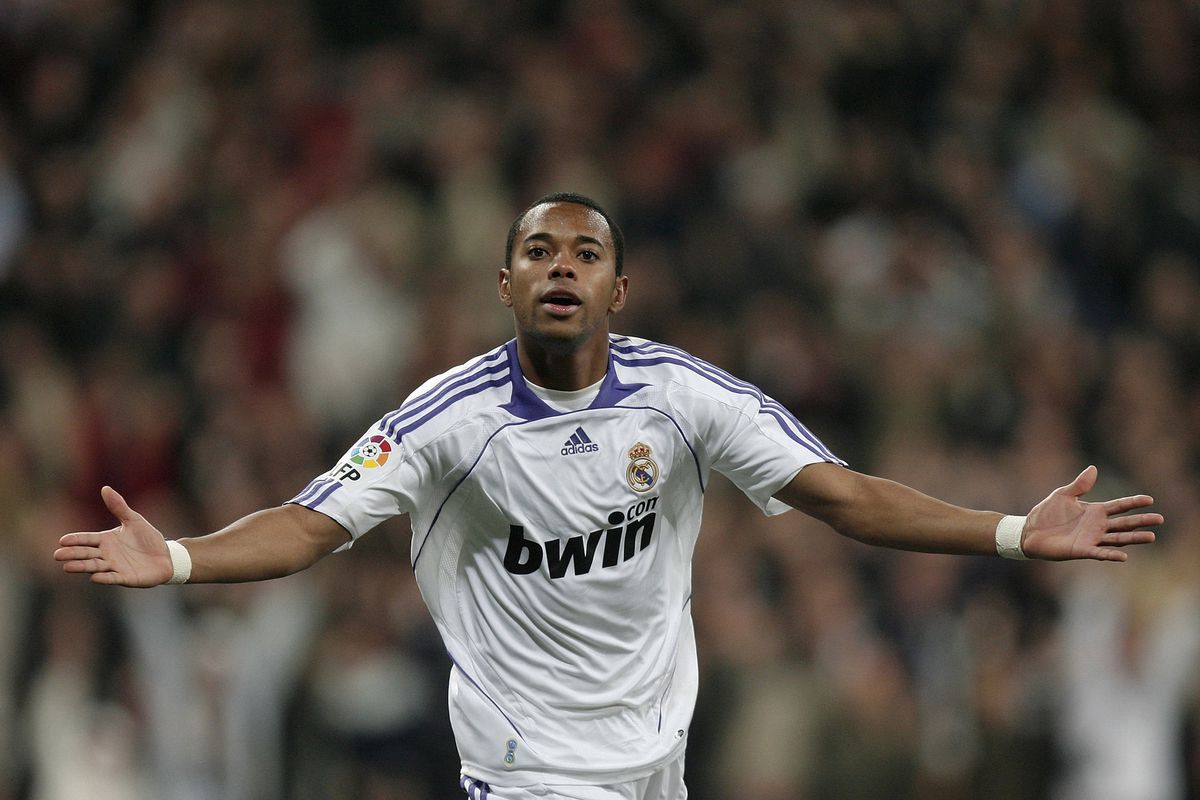
Robinho, once hailed as one of Brazil’s most electrifying football talents, experienced a career that oscillated between brilliant highs and dramatic lows. Known for his dazzling dribbling, flair, and creativity, Robinho was often compared to legends like Pelé early in his career. However, despite his immense potential, his career was marred by inconsistency on the pitch and legal troubles off it, ultimately overshadowing his legacy.
Early Life and Breakthrough at Santos
Robson de Souza, known simply as Robinho, was born on January 25, 1984, in São Vicente, Brazil. Raised in a football-loving culture, Robinho’s talents were evident from an early age. His quick feet, agility, and ability to humiliate defenders with clever dribbling made him stand out. At just 15 years old, he joined the famed Santos youth academy, the same club where Pelé rose to fame.
Robinho made his professional debut for Santos in 2002, and it didn’t take long for him to make an impact. He played a crucial role in helping Santos win the Campeonato Brasileiro Série A in 2002, their first league title since the Pelé era. His flair and quick feet drew comparisons to Pelé himself, who reportedly dubbed Robinho as his “heir.” His performances in Brazil earned him international attention, and soon, European clubs began circling the young prodigy.
Move to Real Madrid: The Next Galáctico
In 2005, Robinho made the high-profile move to Real Madrid for a reported €24 million, positioning him as one of the stars of the club’s “Galácticos” era. He arrived in Spain with enormous expectations, joining a squad filled with world-class talents like Zinedine Zidane, Ronaldo, David Beckham, and Raúl.
Robinho’s time at Real Madrid was marked by flashes of brilliance but also inconsistency. In his debut season, he showed glimpses of the skill and creativity that had made him such a hot prospect. He helped Madrid win two La Liga titles during his time at the club (2006-07 and 2007-08), but his performances were often erratic, and he struggled to cement himself as one of the club’s key players. Despite scoring important goals and providing assists, Robinho never quite reached the heights expected of him at the Bernabéu.
By 2008, his relationship with the club had soured. Real Madrid’s pursuit of Cristiano Ronaldo from Manchester United angered Robinho, who felt undervalued. This led to his eventual departure from the Spanish giants.
Manchester City and the Premier League Experiment
In a dramatic deadline-day transfer in September 2008, Robinho made a surprise move to Manchester City, who had just been acquired by the Abu Dhabi United Group, for a British record transfer fee of £32.5 million. His arrival signaled the beginning of a new era for City, as they sought to challenge the traditional powers of English football.
Robinho’s time in the Premier League started well, as he quickly became a fan favorite at City. He finished his debut season (2008-09) as the club’s top scorer, with 14 Premier League goals. However, despite his initial success, his form began to dip in his second season. His time in Manchester was also plagued by injuries and reports of off-field issues, including his struggles to adapt to the English lifestyle and weather.
In January 2010, Robinho was loaned back to Santos in a bid to rediscover his form ahead of the 2010 World Cup. Though his return to Brazil was seen as a temporary move, it marked the beginning of the decline in his European career.
Return to Brazil and Mixed Success in Europe
Following his loan spell at Santos, Robinho made another high-profile move, this time to AC Milan in 2010. At Milan, Robinho once again showed glimpses of his former brilliance, helping the club win the Serie A title in 2010-11. He formed a solid attacking partnership with the likes of Zlatan Ibrahimović and Alexandre Pato.
However, his inconsistency remained an issue. While he had a decent stint in Italy, Robinho never managed to maintain a consistent level of performance. Over the next few seasons, his influence waned, and by 2014, he found himself loaned back to Santos for another brief stint, followed by a move to Chinese club Guangzhou Evergrande and later Atlético Mineiro in Brazil.
International Career: Mixed Legacy with Brazil
Robinho’s international career with Brazil was also one of mixed fortunes. He made his debut for the national team in 2003 and was part of Brazil’s squad for several major tournaments, including the 2006 and 2010 FIFA World Cups, as well as multiple Copa América tournaments.
At his peak, Robinho was an integral part of the national team, contributing to Brazil’s Copa América win in 2007, where he was the tournament’s top scorer and best player. However, he never quite lived up to the promise of becoming the leading figure in Brazil’s attack, as players like Kaka, Ronaldinho, and later Neymar, overshadowed him.
Legal Troubles and Tarnished Reputation
Robinho’s off-field issues ultimately tarnished his reputation. In 2017, Robinho was convicted in absentia by an Italian court for his involvement in a sexual assault case dating back to 2013 during his time at AC Milan. He was sentenced to nine years in prison, a verdict that he appealed. The legal battle severely impacted his legacy, as it became a focal point of his post-football career.
In 2020, after signing a short-term deal with Santos, Robinho’s contract was terminated following public outcry related to the sexual assault conviction. His legal troubles became a stain on his once-promising career, overshadowing his achievements on the pitch.
Conclusion: A Career of Unfulfilled Potential
Robinho’s career will forever be seen as one of unfulfilled potential. From his early days at Santos, where he was compared to Pelé, to his big-money moves to Real Madrid and Manchester City, Robinho’s talent was undeniable. However, inconsistency, off-field distractions, and legal troubles prevented him from reaching the elite status many had predicted.
While he enjoyed moments of brilliance, winning titles in Brazil, Spain, and Italy, and representing his country on the world stage, Robinho’s legacy is one of what could have been. Today, his name is often associated more with controversy than his footballing genius, a reminder of the fine line between potential and legacy in the world of football.